Sedo vs Afternic: Listing, Fees and Reach Compared
Afternic and Sedo move more retail domain sales than any other venues, and nearly every seller eventually asks which one deserves the listing. The honest answer is that they are complements more than substitutes. Afternic, owned by GoDaddy, syndicates listings across a network of 75,000+ reseller sites and charges commissions in the 15-25% range. Sedo runs its own marketplace, a busy auction program with $79 minimum bids, and the dominant domain parking operation, and takes 10-20%. Here is the line-by-line comparison, followed by a verdict for each kind of seller.
Sedo vs Afternic at a glance
| Factor | Afternic | Sedo |
|---|---|---|
| Model | GoDaddy-owned listing and distribution network | Independent marketplace with auctions and parking |
| Commission | Roughly 15-25%, tiered | 10-20% depending on sale channel |
| Network reach | 75,000+ reseller sites, including GoDaddy search results | Own marketplace plus partners; strongest buyer base in Europe |
| Auctions | No standalone program; expiry auctions live at GoDaddy | Yes; $79 minimum bids and recurring themed events |
| Lease-to-own | Yes, inherited from Dan.com in 2025 | Not the focus; fixed price, offers and auctions |
| Landers and parking | For-sale landers with fast transfer | For-sale landers plus the industry-leading parking program |
| Strongest inventory | .com and mainstream gTLDs | ccTLDs and European names |
| Best for | Maximum buyer reach on .com portfolios | European buyers, ccTLD sellers, auction liquidations |
How big is Afternic's reach, really?
The 75,000+ figure describes reseller sites that surface Afternic inventory, and the practical effect is bigger than it sounds. When someone searches for a taken domain at a partner registrar, your buy-now price can appear directly in the search results, at the exact moment a buyer with a project in mind discovers the name is unavailable. Those are retail buyers, often unaware an aftermarket exists, and they convert at retail prices. GoDaddy's own checkout is part of that surface. Add fast transfer, which hands the buyer the domain within minutes of payment, and an Afternic listing removes nearly every point of friction where a buyer might cool off.
Afternic also absorbed Dan.com, which GoDaddy shut down on June 27, 2025. Dan's signature features, meaning clean landers, lease-to-own and fast transfer, now live inside Afternic, which is why it doubled as the automatic migration path for former Dan sellers.
Where does Sedo still win?
Three places. First, Europe and ccTLDs: Sedo's buyer base and inventory skew European, and for .de, .co.uk, .fr or .nl names it is usually the more liquid venue by a comfortable margin. Second, auctions: Sedo runs a genuine auction program with $79 minimum bids and recurring themed events, which gives sellers a liquidation path Afternic simply does not offer. Third, parking: industry estimates put Sedo's share of the domain parking market at 80-90%, so undeveloped names can sit on Sedo landers earning something while they wait. Temper expectations there, though: without real type-in traffic, parking income typically runs a token $3-5 per month per domain.
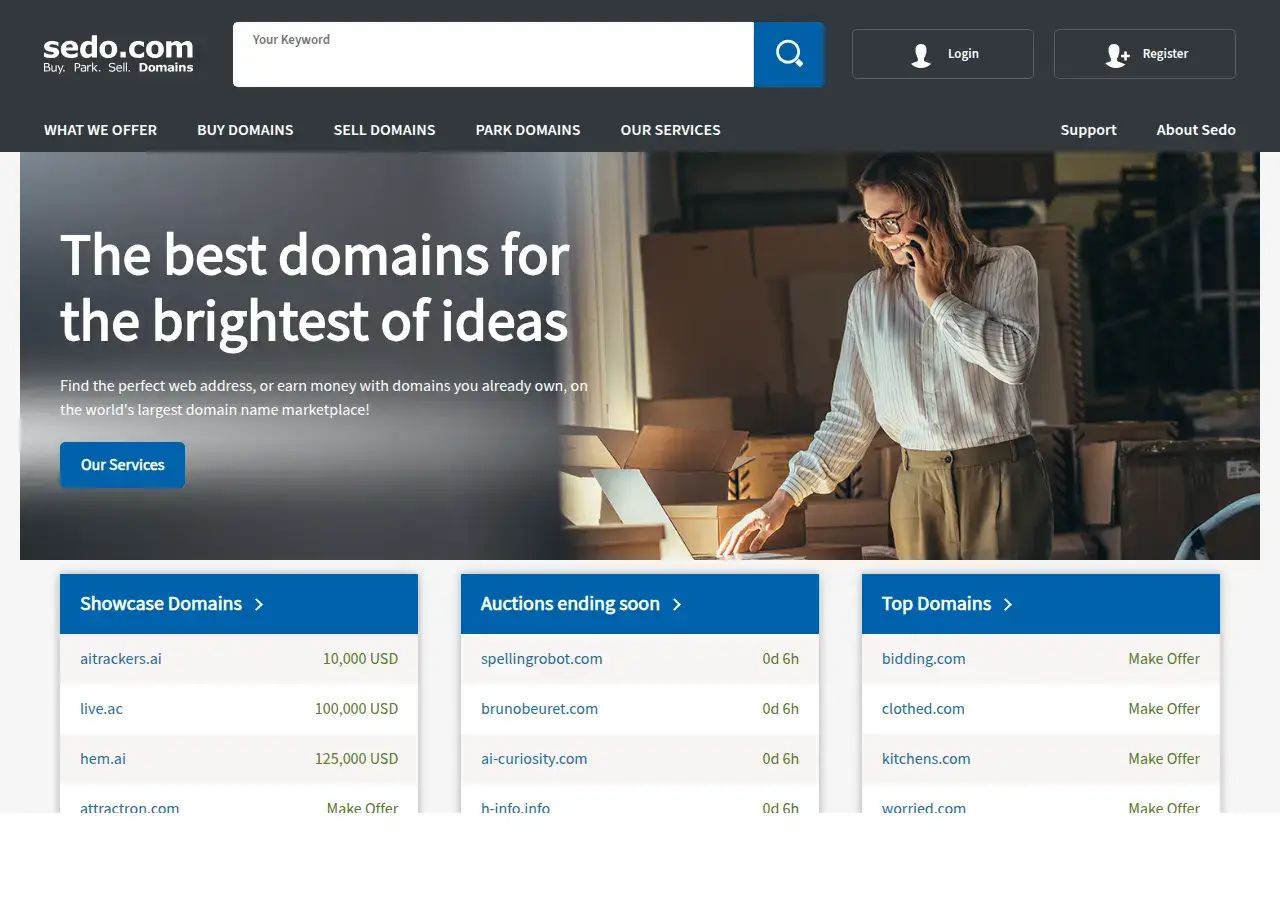
The Sedo marketplace homepage: showcase listings, asking prices and live auctions, captured August 2026
What do the fees look like on a real sale?
Take a $2,000 sale. At Afternic's roughly 15-25% you net about $1,500-1,700. At Sedo's 10-20% you net about $1,600-1,800. Sedo looks cheaper on paper, and often is, but the comparison only matters if both venues would have produced the sale. A buyer who only ever saw the name inside a registrar search box is an Afternic buyer, and the commission on a sale that never happens is irrelevant. Exact tiers shift with listing type and promotion, so check current schedules before you commit; the ranges above hold as of mid-2026.
Where does GoDaddy's own aftermarket fit?
Sellers often conflate Afternic with GoDaddy's aftermarket because one parent owns both and the inventory overlaps at the checkout layer. The practical split: Afternic is the listing and distribution network, while GoDaddy's aftermarket adds expiry auctions and its own listing surface, with seller commissions commonly in the same 15-25% band and an auctions membership costing about $5 a year. Listing through Afternic already puts your name in front of GoDaddy's buyers, so there is no need to manage both sides; the auction machinery only matters when you are liquidating inventory or buying it. Treat them as one distribution decision with two doors.
Lander quality and the type-in buyer
Whoever hosts your lander owns the type-in buyer, the person who visits the domain directly to see whether it is for sale. Both platforms provide for-sale landers with inquiry or buy-now flows. Afternic's landers inherit Dan.com's conversion-focused design and support lease-to-own, which turns a four-figure asking price into monthly installments and widens the pool of buyers who can say yes. Sedo's landers can pair the for-sale message with parking ads. You can hold listings on both networks at once, but the domain's DNS can only point at one lander, so decide which platform gets the direct visitor before a buyer shows up.
From listing to payout: how the process runs
Both venues follow the same broad sequence: verify you control the domain, set a buy-now price or accept-offers threshold, and let the listing propagate. When a buyer pays, the platform holds the funds, the domain transfers (instantly on fast-transfer names, manually otherwise), and the seller is paid out after the transfer completes. Neither platform publishes a single universal payout timetable; in practice, speed depends on the transfer method and how you choose to be paid, with fast-transfer sales settling quickest.
Verdict by seller type
- Volume .com portfolio: Afternic first for the network effect, Sedo as the second listing. Reach beats rate.
- European or ccTLD inventory: Sedo first; its buyers are your buyers.
- Need cash out this quarter: Sedo's auction program, with its $79 minimums, is the realistic liquidation route.
- Invented brandables: Neither is ideal; curated venues fit better, as covered in our 12-marketplace comparison.
- One genuinely premium name: List on both, keep prices identical everywhere, and consider a broker for anything with six-figure potential.
One margin note for flippers: if you restock from the expired pipeline, researching drops and expiry auctions in a tool like DomCop (paid plans from roughly $68 per month, no free trial, 2-day money-back guarantee), commission is a first-class number in your math. A name caught for $60 and sold for $2,000 nets meaningfully different profits at 10% versus 25%, and that gap compounds across a portfolio.
Frequently asked questions
Is Sedo or Afternic cheaper?
Sedo's 10-20% commission undercuts Afternic's roughly 15-25% on paper. In practice the cheaper venue is whichever one actually produces the buyer, and for mainstream .com inventory that is usually Afternic's network.
Do Afternic and Sedo share listings?
No. They are separate networks with separate buyer pools, which is exactly why experienced sellers list on both. Keep pricing identical everywhere and remove the second listing promptly once a name sells.
What happened to Dan.com?
GoDaddy shut Dan.com down on June 27, 2025 and folded it into Afternic. Lease-to-own, fast transfer and the lander design carried over, so former Dan sellers lost the brand rather than the features.
How fast do Sedo and Afternic pay out?
Both release funds after the domain transfer completes, so timing mostly depends on how quickly the transfer clears and which payout method you chose. Fast-transfer-enabled names settle quickest because the handover is automated.