From $99 Catch to $5,000 Exit: Selling Caught Domains
Most retail domain listings began life as somebody's cheap catch. The $2,500 buy-now name on a marketplace was, a year or two earlier, an expiring domain that an investor spotted, backordered for two or three figures and repriced for its end user. What follows is an illustrative walkthrough of that method from first filter to final invoice. The numbers in the worked example are deliberately typical rather than a real transaction, and the failure rates are included on purpose, because they are most of the story.
Step 1: research the drop before it happens
Every day, on the order of 100,000 domains are listed as dropping and 200,000+ are deleted in total, and nearly all of them deserve to die. The job is filtering. Two tools dominate the research layer: ExpiredDomains.net, free with registration and covering 676 TLDs, and DomCop, a paid aggregator (annual plans from roughly $68 per month) that layers backlink, authority and spam metrics onto the same firehose so you can sort by quality instead of opening names one at a time. Whichever you use, the filters that matter are the same: real backlinks from real sites, a Majestic TF:CF ratio above roughly 0.3 (below that is a classic spam signal), a Moz spam score under 10%, and a name an end user could plausibly want. Cross-check authority scores between tools; the same site can differ by 26 points on average between metrics vendors.
Step 2: backorder it for under $100
Once a target enters pendingDelete, you cannot buy it, only race for it, and the race is outsourced to drop catchers. DropCatch runs 1,200+ registrar accreditations and charges $13-59 per backorder; if several customers order the same name, the catch goes to a public auction among them. NameJet and SnapNames share one inventory pool with $69-79 minimums, so never order the same name on both. For .io, .ly and .sh, park.io built the standard playbook: $99 flat, pay only on success, with a 10-day auction if multiple buyers ordered it. Set expectations now: even top catchers land an estimated 30-50% of contested names they chase, so a shortlist of ten targets might return three to five catches, and auctions on the good ones will push some past $100.
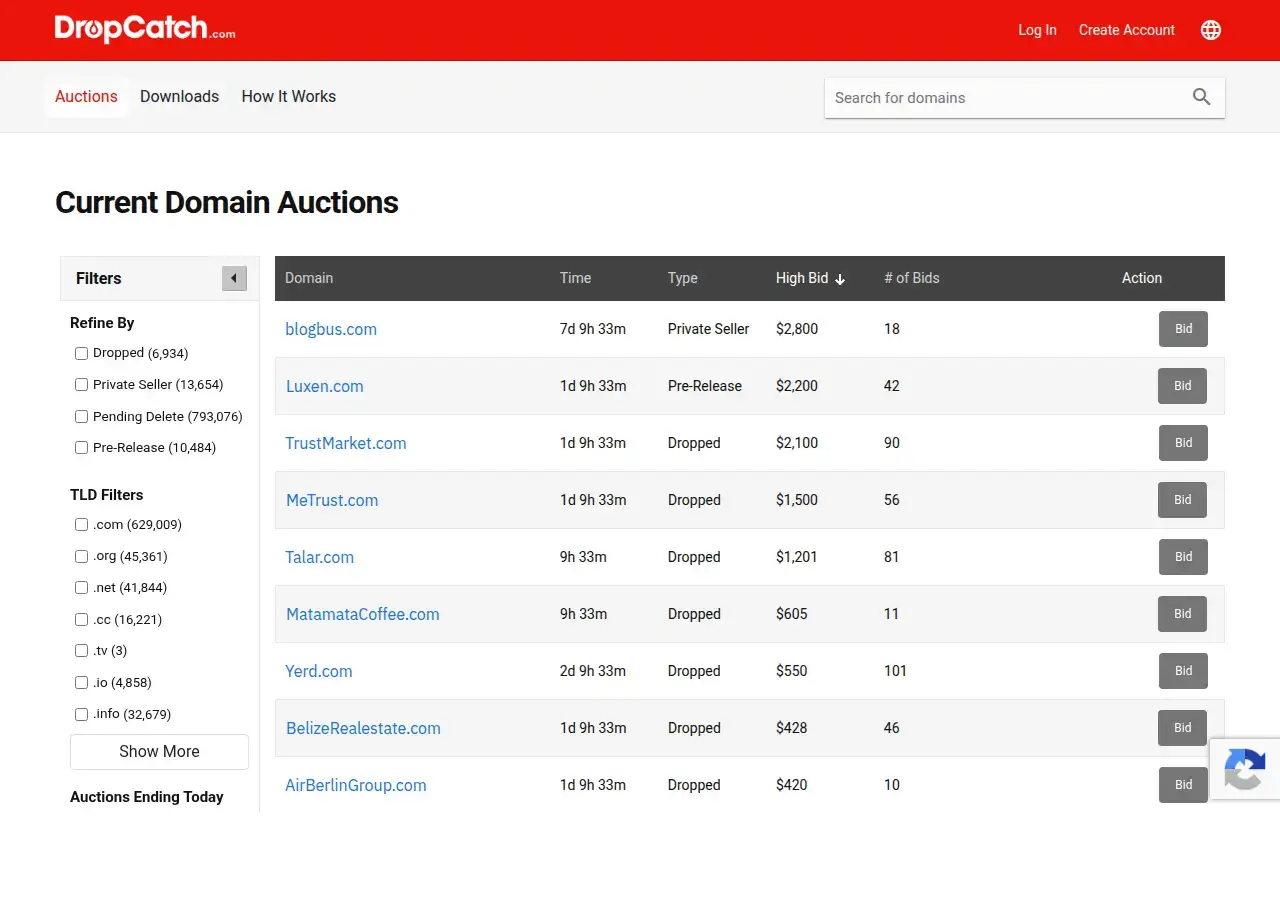
DropCatch's public auctions, where contested backorders end up when several buyers order the same name, captured August 2026
Step 3: vet what you actually caught
The drop resets registration and WHOIS history, but it does not reset the name's past, and the past is what you are reselling. Before listing anything, walk the Wayback Machine history at web.archive.org: what lived on this name, in what language, and did it end life as a casino redirect? Check the anchor text profile for pharma and gambling terms. Accept that some catches fail vetting after you own them; the correct response is to let them expire rather than pour renewals into damaged goods. And do not oversell what a caught name gives a buyer: domain age alone builds no email sender reputation, so a caught name is a brand and SEO asset, not a deliverability shortcut.
Step 4: list it where end users shop
Wholesale venues pay wholesale prices, so caught names earn their margin at retail venues. The default play is an Afternic listing, which syndicates across its 75,000+ reseller network at commissions commonly between 15-25%, plus a for-sale lander on the name itself so direct type-in buyers can find the buy button. Sedo adds European and ccTLD reach at 10-20% commission. Choose buy-now pricing for names under about $5,000; the venue-format tradeoffs are analyzed in buy now vs make offer vs auction, and offering installments widens the buyer pool, as covered in lease-to-own domains.
The margin math, honestly
Here is the worked example the title promises, as an illustration of the method. Suppose a two-word .io brand name drops, you catch it through park.io, and 20 months later a startup pays your buy-now price:
| Line item | Illustrative figure | Notes |
|---|---|---|
| Backorder catch | -$99 | park.io flat fee, charged only on success |
| Renewals (2 years) | -$80 | Carrying cost while the listing waits |
| Listing and lander | $0 | Afternic listing free; commission comes out at sale |
| Sale price | +$5,000 | Buy-now purchase by an end user |
| Commission (20%) | -$1,000 | Mid-range of the common 15-25% band |
| Net profit | +$3,821 | Over roughly two years, on this one name |
Now the portfolio correction. Industry consensus puts sell-through at roughly 1-2% per year, so the realistic unit is not one name but twenty or fifty. Suppose twenty catches at an average $60 all-in cost $1,200, plus around $300 a year in renewals. One sale like the example above, landing sometime in two years, covers the entire portfolio and leaves real profit; zero sales in that window is also entirely possible. This is a patience business with a lottery bolted on top, and the players who last treat renewals as the real recurring bet.
Why most caught names never exit
Four failure modes eat beginners. You lose contested catches, often more than half of the ones worth having. Some wins fail post-catch vetting and become write-offs. Some names are fine but priced on hope rather than comparable sales, and sit for years; NameBio comps are the antidote. And renewal bleed quietly converts a $60 bargain into a $200 mistake by year three. The discipline that separates a pipeline from a graveyard is annual culling: re-buy each renewal decision as if it were a fresh purchase, and let the rest go. For the selling mechanics themselves, from landers to timelines, see how to sell a domain.
Frequently asked questions
How much money do I need to start flipping caught domains?
A workable illustrative budget is $500-1,500 for the first year: a handful of backorders at $13-99 each, renewals, and optionally a research subscription. The bigger investment is time spent filtering drop lists until your shortlists get good.
Do I need DomCop, or is ExpiredDomains.net enough?
ExpiredDomains.net covers discovery free of charge, and plenty of investors start there. DomCop earns its fee (from about $68 per month on annual billing) when volume matters, by putting the quality metrics in one sortable place; there is no free trial, but there is a 2-day money-back guarantee. Pay for it when filtering speed, not idea supply, is your bottleneck.
How long until a caught domain sells?
Months to years, and possibly never. At 1-2% annual sell-through, any single name is more likely to wait years than to sell this quarter. Price at retail, keep the lander up, and let the portfolio, not one name, carry your expectations.
What happens if someone else backorders the same domain?
On DropCatch the winners' auction decides it among everyone who ordered; on park.io a contested catch triggers a 10-day auction. Your $13-99 entry becomes a bidding contest, which is exactly when a pre-set maximum price protects you from winning yourself into a loss.